

Reviewed · OAHU SEGWAY TOURS
History & Culture Tour in Honolulu via Segway
Honolulu’s past comes into focus quickly on this small-group Segway tour, which links royal landmarks, old commercial streets, Chinatown, the harbor, and the coast in one morning. You glide farther than you could comfortably walk, while a headset lets your guide explain what you’re seeing without shouting across traffic or a line of riders.
I like the way the tour connects famous places, such as Iolani Palace and the King Kamehameha Statue, with less obvious corners like Merchant Street, the Ehime Maru Memorial, and Honolulu’s old transportation buildings. I also like the personal feel: the group is capped at eight, and guides including Jeanne, Michael, Zach, and Allen have earned praise for clear instruction, local stories, photography help, and careful attention to each rider.
The main consideration is price. At $254.14 per person, this is far more costly than a self-guided walk or city bus ride. You also need to reach the Kaka’ako meeting point, unless you pay another $20 per person for round-trip Waikiki transport.
In This Review
- Key points to know before you book
- Why a Segway works well for historic Honolulu
- Mission Houses and Kawaiahao Church begin the story
- The King Kamehameha Statue and the former seat of government
- Iolani Palace and Queen Lili’uokalani’s final royal chapter
- The State Capitol and Hawaii’s public face
- Hotel Street, Chinatown, and everyday Honolulu
- Merchant Street, Bishop Street, and Honolulu’s old business district
- Aloha Tower and the harbor’s changing waterfront
- Kaka’ako Waterfront Park and the oceanfront return
- What $254.14 buys you
- Who should choose this Honolulu tour
- Should you book the History and Culture Tour?
- FAQ
- How long is the History and Culture Tour in Honolulu?
- What time does the tour start?
- Where does the tour meet?
- Where does the tour end?
- How many people can join the tour?
- Is Waikiki transportation included?
- What is included in the tour price?
- Is the tour offered in English?
- What happens if I need to cancel?
Key points to know before you book
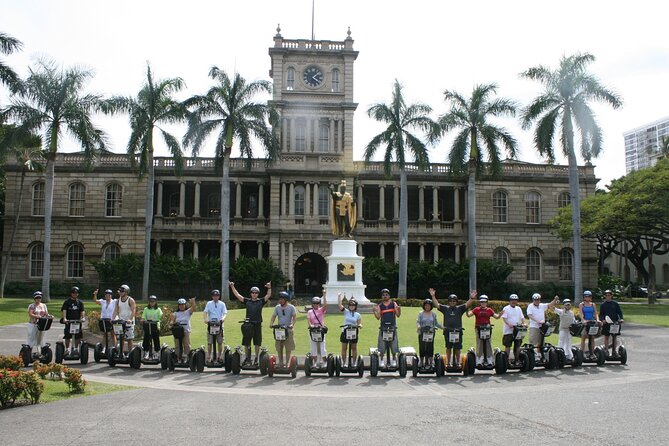
- Iolani Palace anchors the story: You see the only palace on American soil built by a Hawaiian king, along with royal statues, banyan trees, and nearby civic buildings.
- The Segway saves time and effort: You can cover downtown, Chinatown, Honolulu Harbor, Kaka’ako, and the oceanfront in about two and a half hours.
- Communication is unusually easy: A two-way radio headset lets you hear the guide while riding, and the guide can hear your questions.
- The group stays small: A maximum of eight riders makes it easier to get help, ask questions, and keep together.
- The route mixes monuments with ordinary Honolulu: Open markets, noodle factories, old streets, coral reef restoration, and waterfront parks give the ride local texture.
- Waikiki pickup costs extra: Four pickup points are available, but round-trip transport to Kaka’ako costs $20 per person.
Why a Segway works well for historic Honolulu
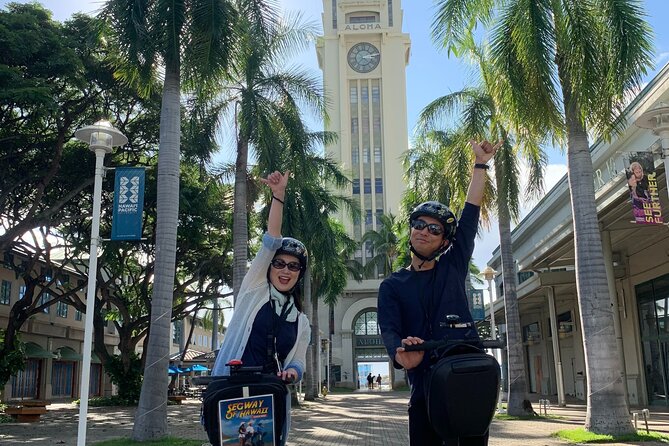
A walking tour of central Honolulu can be rewarding, but the distances add up. This route reaches the old royal center, Chinatown, the harbor, and Kaka’ako Waterfront Park before returning along Ala Moana Regional Beach Park. On foot, that would require more time and energy, with less room for the coastal portion.
You do not need to be an experienced Segway rider. The guides provide instruction, a colorful helmet, and radio equipment, and the supplied feedback suggests first-time riders generally get comfortable quickly. One family had never ridden before and found the coaching reassuring. Another pair, already familiar with Segway tours in other American cities, rated this route among their best.
That does not mean the machine is right for everyone. You need to feel comfortable balancing on a moving platform and staying with the group in single file. The tour is described as suitable for most people, but anyone unsure about riding should consider that this is an active experience, not a seated bus excursion.
The two-way headset is a real advantage. You can listen while gliding instead of stopping at every monument, and you can ask a question without interrupting the whole group. Guides also take photos, according to the supplied experiences, which is useful when your hands are occupied with the Segway.
More segway tours around Honolulu:
- Honolulu: Diamond Head Segway Tour
★ 5.0 · 37 reviews - Honolulu: Magic Island & Beach Segway Tour
★ 5.0 · 10 reviews - Honolulu: Historic Downtown Segway Tour
★ 5.0 · 6 reviews
Mission Houses and Kawaiahao Church begin the story
The first stop brings you to the Mission Houses, a small group of austere buildings dating to 1820. These structures relate to Hawaii’s first missionaries and offer a useful starting point for understanding how outside religious and political forces became part of Honolulu’s story.
Next door is Kawaiahao Church, also built in 1820. Its graveyard contains the remains of former Hawaiian ali’i, or royalty. This is an important pause because the tour is not only about grand palaces. It also shows how faith, government, burial places, and royal power occupied the same compact part of town.
Across King Street, you’ll see Honolulu Hale, the city hall. The contrast is worth noting: early missionary buildings, a historic Hawaiian church, royal burial grounds, and a modern civic building all sit close together. Your guide can help connect those layers rather than leaving you with a string of dates and names.
The stop also gives you a gentle introduction to the pace of the experience. You glide between sites, pause for explanation, and then move on before the morning becomes tiring. If your main interest is Hawaiian history, these opening landmarks provide the context needed for the royal sites that follow.
The King Kamehameha Statue and the former seat of government
The gold-encrusted King Kamehameha Statue is one of the route’s most recognizable photo stops. It sits in front of Hawaii’s State Supreme Court building, a structure that once served as the seat of Hawaii’s government when the islands were a nation.
The setting does more than frame a famous statue. It places a powerful Hawaiian ruler beside the legal and political center of present-day Hawaii. That shift in government is one of the central themes of the morning, and the guide’s spoken explanation gives the monument more meaning than a quick photograph alone.
You’ll want to listen closely here. The tour’s strongest feature is not simply reaching each landmark, but hearing how the places relate to one another. Guides have been praised for sharing material that is not always offered in a standard sightseeing stop, and this is the kind of location where extra context matters.
Iolani Palace and Queen Lili’uokalani’s final royal chapter
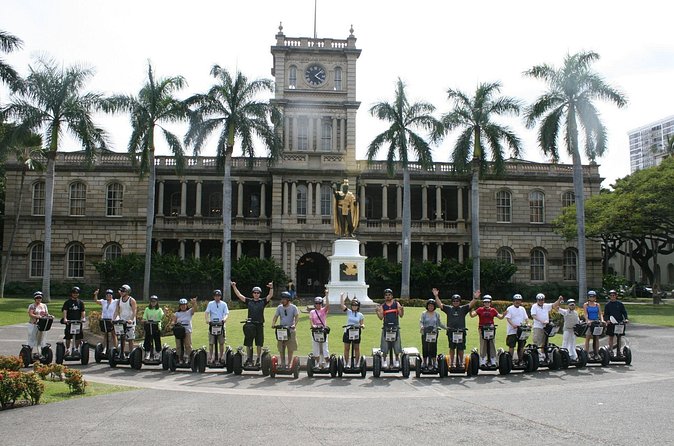
You then cross King Street into the grounds of Iolani Palace and the Royal Barracks. Iolani Palace was built by King Kalakaua and is the only palace on American soil built by a Hawaiian king. Today it functions as a museum, although this Segway outing glides around the grounds rather than serving as a full interior palace visit.
That distinction matters. If you want a room-by-room palace tour, you’ll need a separate visit. Here, the value is seeing the building in its civic setting, learning about the monarchy, and moving around the grounds without spending the entire morning in one place.
The route includes banyan trees and a stop at the statue of Queen Lili’uokalani, Hawaii’s last ruling monarch. Her story is essential to understanding Honolulu. The Hawaiian government was overthrown by Americans, and her statue marks a painful turning point in the islands’ political history.
This part of the tour is especially useful for first-time visitors who know Iolani Palace as a landmark but not as a symbol. The guide can explain the change from Hawaiian nation to American-controlled government while you see the buildings connected to that transition.
More history trips on Honolulu:
- Oahu: Mauka Warriors Luau Honoring Polynesia’s Forgotten History
★ 5.0 · 3,013 reviews - Pearl Harbor with USS Arizona and Hawaiian Kingdom History Tour
★ 4.5 · 184 reviews - Pearl Harbor [Early Access], USS Arizona & Historic Honolulu Tour
★ 4.5 · 87 reviews - Semi Private Honolulu Historical Tour
★ 5.0 · 11 reviews
The State Capitol and Hawaii’s public face
Behind the palace, the route continues to Hawaii’s State Capitol Building. Its architecture is described as distinctive, and the stop adds a modern civic counterpoint to the palace grounds.
I like this sequence because it lets you compare two kinds of government buildings within a short ride. Iolani Palace expresses royal power, while the Capitol represents the state’s current political system. The buildings help make the political story visible instead of leaving it as an abstract lecture.
You’ll also pass the Hawaii State Art Museum. The tour does not present it as a full museum visit, so treat it as part of the city ride rather than a substitute for an art appointment. Still, its location helps you see how this part of Honolulu combines government, history, and public culture.
Hotel Street, Chinatown, and everyday Honolulu
The route then moves along historic Hotel Street toward Chinatown. This section changes the tone. Instead of royal monuments and formal government buildings, you see a district shaped by commerce, migration, food, and daily life.
Chinatown’s shopping mall includes noodle factories and open markets, with people from many parts of the world. That makes this one of the more useful stops for understanding Honolulu as a living city rather than a collection of preserved buildings. The route gives you a look at working streets and immigrant influences alongside the better-known royal story.
The guide’s radio commentary helps here because the streets can offer more than you can absorb at a glance. You may notice the markets first, but the explanation can point out how the district fits into Honolulu’s changing population and commercial past.
There is also a practical limitation. You glide through this area rather than stopping for a long food crawl or market visit. If Chinatown’s restaurants and shops are high on your list, return later with time to explore on foot.
Merchant Street, Bishop Street, and Honolulu’s old business district
From Chinatown, you head toward Bishop Street, described as Honolulu’s Wall Street. You also travel along Merchant Street, the first paved street in Honolulu, where artistic buildings and old transportation structures remain part of the route.
This is a good reminder that history is not confined to palaces. Streets built for trade, banking, transport, and shipping shaped Honolulu just as much as royal ceremonies did. The buildings may look less dramatic than Iolani Palace, but they explain how the city worked.
The historic transportation buildings are more than 150 years old. Seeing them by Segway gives you a broad view of the district, while the guide fills in the practical story of movement and commerce. You can cover several blocks without the stop-and-start fatigue that often comes with a long city walk.
If architectural detail is your main interest, ask questions through the headset. The group size allows for personal attention, and the guides have been praised for handling questions well. You may get more from this section if you treat it as a conversation rather than simply following the route.
Aloha Tower and the harbor’s changing waterfront
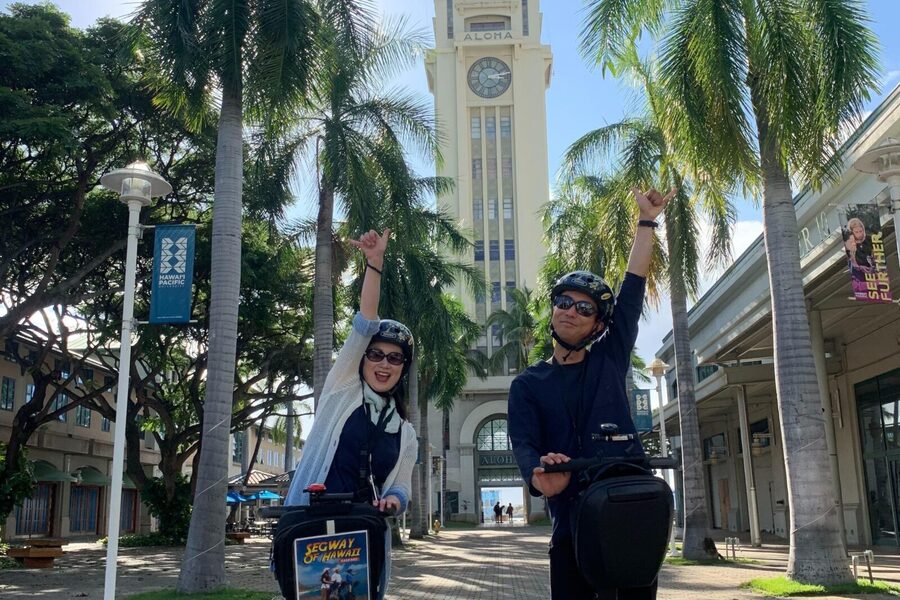
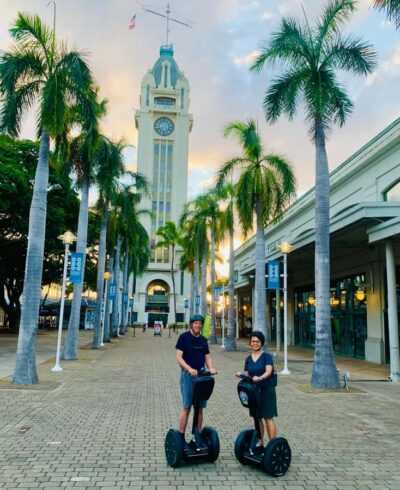
At Honolulu Harbor, you reach Aloha Tower. When it was built in 1926, it was the tallest building in Hawaii. For ocean arrivals, it became an important visual marker and a symbol of Honolulu’s connection to ships and trade.
The harbor stop adds a different kind of history. The earlier landmarks focus on monarchy, religion, and government. Aloha Tower shifts the story toward transportation, commerce, and the arrival of people by sea.
You’ll also see a restored coral reef and fish that now come close to feed. This environmental feature gives the harbor stop a present-day angle, showing how a working waterfront can also support marine life. It is a small detail, but one that keeps the tour from becoming only a procession of old buildings.
The harbor can be a good place for photographs, and the guide may help with that. Bring your attention as well as your camera, since this is where the tour’s central idea comes together: you are using modern technology to move through places shaped by centuries of Hawaiian change.
Kaka’ako Waterfront Park and the oceanfront return
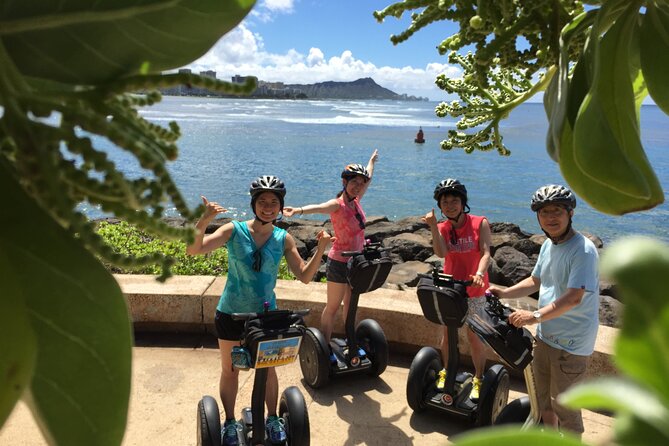
After the harbor, you glide toward Kaka’ako Waterfront Park. The promenade gives you open views and a chance to see surfers at Point Panic. This is the route’s most relaxed stretch, with less emphasis on formal buildings and more on Honolulu’s shore.
You then head uphill to the Ehime Maru Memorial and the Echo Stone. The provided route description ends abruptly after mentioning the Echo Stone, so the exact amount of time spent at these features is not specified. Still, their inclusion adds a more recent and reflective note to a morning that has mostly focused on the nineteenth and early twentieth centuries.
The final ride follows the ocean through Ala Moana Regional Beach Park back to the starting point. It is a pleasant way to finish because you have moved from inland civic landmarks to the working harbor, then out to the open waterfront.
This coastal return also gives you a sense of Honolulu’s geography. You are not simply being driven between isolated attractions. You see how the older center connects with Kaka’ako and Ala Moana, and how the city meets the water at several different kinds of shoreline.
What $254.14 buys you
The listed cost is $254.14 per person, which puts this firmly in the premium activity category. The price includes bottled water, a guide, a helmet, and the two-way radio headset. It does not include gratuity, which is appreciated, or Waikiki transportation.
The value depends on how you like to sightsee. If you want an efficient route, live commentary, a small group, and an unusual way to move through central Honolulu, the cost may make sense. You are paying for the machine, instruction, guide time, route planning, and the ability to cover a wide area in one morning.
If your budget is tight, the price will be hard to justify. You can visit some of these public areas independently, and Iolani Palace or other museums can be planned separately. The Segway is the reason to book this particular experience, not merely a way to reach free landmarks.
The average booking window is 54 days ahead, so reserve early if your schedule is fixed. The tour starts at 9:00 a.m. and lasts about two hours and 30 minutes. It ends where it begins, at Segway of Hawaii in Kaka’ako.
If you are staying in Waikiki, four pickup locations are available for an added $20 per person round trip. Contact Segway of Hawaii in Kaka’ako to arrange pickup. Otherwise, plan your own trip to StoreKeeer Building, 1687 Kalauokalani Way, Honolulu.
Who should choose this Honolulu tour
I would choose this for a history-minded visitor who wants more ground covered than a walking tour allows. It also suits repeat visitors who have seen Waikiki’s main strip and want to understand downtown Honolulu, Chinatown, the royal district, and the harbor.
Families and couples can benefit from the small group, especially if one person is nervous about riding. Guides such as Michael and Zach have been praised for making first rides feel easy, while Jeanne has been singled out for strong explanations and thoughtful answers. Allen and Jeanne have also been noted for tailoring the outing to a family’s interests.
The tour works well if you have only a few hours and want a broad introduction. It is less suitable if you want long interior visits, extended market shopping, or a slow architectural walk. The ride gives you the framework. You can then return to the places that deserve more time.
The experience requires good weather. If poor weather forces cancellation, you’ll be offered another date or a full refund. You can cancel up to 24 hours before the start for a full refund, but changes or cancellations inside that window are not accepted. A minimum number of riders is also required, and if it is not met, you’ll be offered another option or a refund.
Should you book the History and Culture Tour?
Book it if you value local explanation, efficient sightseeing, and a small group more than a low price. The route is unusually broad, the headset makes conversation easy, and the guides bring personality to a subject that can otherwise feel like a list of monuments.
Skip it if $254.14 feels excessive, if you dislike balancing on a Segway, or if your priority is spending serious time inside Iolani Palace, shopping in Chinatown, or relaxing at the beach. For the right rider, though, this is a smart way to connect Honolulu’s royal past, civic present, working harbor, and oceanfront in one well-paced morning.
FAQ
How long is the History and Culture Tour in Honolulu?
The tour lasts approximately two hours and 30 minutes.
What time does the tour start?
The listed start time is 9:00 a.m.
Where does the tour meet?
You meet at Segway of Hawaii in Kaka’ako, at StoreKeeer Building, 1687 Kalauokalani Way, Honolulu, HI 96814.
Where does the tour end?
The activity ends back at the Kaka’ako meeting point.
How many people can join the tour?
The tour has a maximum of eight travelers.
Is Waikiki transportation included?
No. Round-trip transportation from Waikiki is available for an additional $20 per person. There are four Waikiki pickup locations, and you need to contact Segway of Hawaii in Kaka’ako to schedule pickup.
What is included in the tour price?
The price includes bottled water, a tour guide, a colorful helmet, and a two-way radio headset.
Is the tour offered in English?
Yes. The tour is offered in English, and a mobile ticket is available.
What happens if I need to cancel?
You can cancel up to 24 hours before the start time for a full refund. Cancellations or changes made less than 24 hours before the start are not accepted for a refund. Poor weather or failure to meet the minimum number of riders may result in another date, another experience, or a full refund.
Just added around Honolulu
- Waikiki: Sunset Swim & Sailing Experience★ 4.5 · 3 reviews
- Oahu : Hanauma Bay Reservation+Equipment Rental★ 3.3 · 3 reviews
- Diamond Head Hike [Starts at 7:00 a.m.]★ 3.5 · 3 reviews
- Self Guided Hike Trail to Nature Walk & Waterfall★ 3.2 · 3 reviews
- Private Transfer waikiki to HNL airport * 1-12 passenger*★ 4.7 · 3 reviews
- Kevo’s Beach Bus★ 5.0 · 3 reviews
- Half-Day Waterfall Tour – Hike, Scenic, Food and Photo★ 5.0 · 3 reviews
- Private Transfer Honolulu Airport HNL to Waikiki by Sedan★ 4.5 · 3 reviews
Oahu Segway Tours, compared.

Browse the lists this tour appears in