
Reviewed · WALKING TOURS
Honolulu Downtown Walking Tour
Honolulu’s downtown tells the story of Hawaii in a compact area. In about 70 minutes, you move from the imposing King Kamehameha Statue to royal, religious, and government landmarks, while a local guide explains how an independent Hawaiian kingdom became a US state. The history is the main event, not the walking.
I like the tour’s very low $5 price and its easy route, which suits first-time visitors and anyone who wants useful context before exploring Oahu. I also like the focus on people and political change, especially the Hawaiian monarchs and the role of mainland Americans and Europeans. The trade-off is clear: you will spend a lot of time standing and listening. If you expect a long stroll with many attractions entered, this may feel too stationary.
In This Review
- Key points to know before you go
- Why downtown Honolulu matters
- King Kamehameha Statue and the making of Hawaii
- Aliiolani Hale and the world of Hawaiian royalty
- Iolani Palace, the heart of the monarchy story
- From kingdom to territory to state
- Kawaiahaʻo Church and a different side of Honolulu
- King Lunalilo Mausoleum and the final royal chapter
- The guide makes or breaks the experience
- A short walk with plenty of standing
- What the $5 price really buys you
- Who should book this Honolulu walk
- My call: book it for context, not mileage
- FAQ
- Where does the Honolulu Downtown Walking Tour begin?
- What time does the tour start?
- How long does the tour last?
- Where does the tour finish?
- How much does the tour cost?
- Is the tour offered in English?
- Is this tour in Waikiki?
- How much walking is involved?
- What happens if the weather is poor?
Key points to know before you go
- Six central Honolulu landmarks: The route links royal, religious, government, and civic sites within roughly half a mile.
- Susan is a frequently praised guide: She is known for clear storytelling, thoughtful answers, and a strong grasp of Hawaiian history.
- More talk than walking: The route is easy for most fitness levels, but much of the time is spent at stops.
- A useful first-day orientation: The tour gives you a framework for understanding Hawaii’s monarchy, unification, territorial period, and statehood.
- Outside Waikiki: You meet in downtown Honolulu at the King Kamehameha Statue, not in the resort district.
- Excellent value at $5: The price is hard to beat, provided you want a history-focused introduction rather than a major sightseeing circuit.
Why downtown Honolulu matters
Waikiki gets most of Oahu’s attention, but downtown Honolulu explains far more about the islands’ political and cultural story. This is where you encounter the monarchy, state government, historic churches, public institutions, and memorials connected with Hawaii’s changing identity.
The experience begins at 9:00 am in front of the King Kamehameha Statue at 447 South King Street. That early start works well in a busy Honolulu schedule. You can take the tour before a later activity, and the morning timing avoids building the whole day around a long excursion.
You should arrive at the statue rather than Waikiki and allow time to get there. The meeting point is near public transportation, but the tour does not include transportation from your hotel. Guides wear a white or black Hawaii Free Tour shirt, which helps you identify the group.
The group can reach 30 people. That is not a tiny private walk, so staying close to the guide matters. On the other hand, the short route and fixed stopping points make the format fairly manageable.
More walks around Oahu:
- Self guided Hike Trail to Nature Walk & Waterfall
★ 4.5 · 283 reviews - Honolulu Haunts: Ghosts and Spirits Walking Tour
★ 4.2 · 169 reviews - Kualoa Ranch – Horseback Walking Tour
★ 4.0 · 145 reviews
King Kamehameha Statue and the making of Hawaii
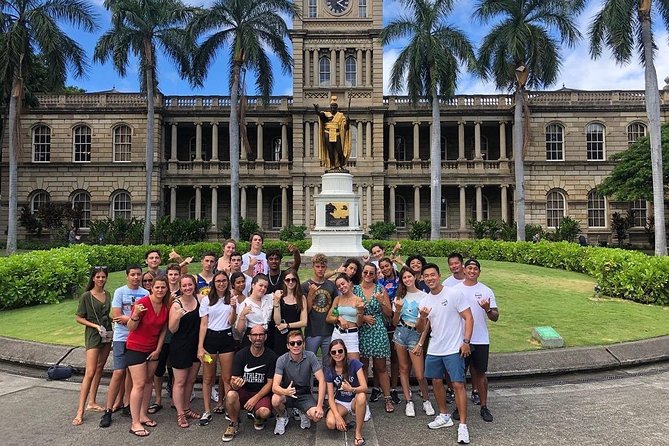
The first stop, the King Kamehameha Statue, is a fitting place to begin. The figure honors Kamehameha I, the ruler associated with bringing the Hawaiian Islands together under one monarchy.
Your guide uses this opening to discuss Polynesian and Austronesian origins, the Hawaiian people, and the formation of Hawaii as an independent nation. This gives the tour a broader starting point than simply beginning with European arrival.
That matters because Hawaii’s story did not begin with foreign ships. Starting with the people who settled and developed the islands helps put later political events in the right order. You get an introduction to Hawaii as a society with its own leadership, culture, and government before outside powers changed its direction.
The statue itself is free to visit, and you do not need a ticket. Expect to stand while the guide speaks. This is a good place to listen closely, take photographs, and get a sense of the tour’s teaching style.
Aliiolani Hale and the world of Hawaiian royalty
The route also includes Aliiolani Hale, a major civic building near the statue. The schedule does not assign it a separate time block, but it fits naturally into the discussion of Honolulu’s royal and government center.
This part of the walk helps connect the personalities of Hawaii’s rulers with the buildings around them. The focus is not only on names and dates. You hear how Hawaiian leadership developed and how foreign influence affected the kingdom.
The tour is strongest when the guide makes chronology understandable. Susan, who led many of the highly praised tours, is described as a warm and entertaining storyteller who answers questions in plain language. That is useful here, since Hawaiian royal history can become a blur of unfamiliar names if it is delivered as a list.
One reviewer specifically valued the discussion of Hawaiian aliʻi, the chiefs and nobles of the traditional political order. You can expect attention to the people behind the institutions, not just the architecture.
Iolani Palace, the heart of the monarchy story
Iolani Palace receives about 15 minutes of discussion. It is the clearest physical reminder that Hawaii was once a recognized monarchy with its own royal household and political life.
The guide explains the different monarchs and examines how European and US mainland influence shaped Hawaii. That subject can be uncomfortable, and it should be. The story involves shifting power, outside economic interests, and the eventual end of the Hawaiian Kingdom.
This is one of the most valuable parts of the walk for a first-time visitor. You may see the palace independently, but a guide can help place it within the sequence of rulers and political changes. The visit also gives you a better sense of why later Hawaiian history cannot be reduced to a simple tale of American expansion.
The tour does not list an interior palace visit or an admission ticket. Plan on discussing and viewing the site from the walking route rather than assuming you will enter. If you want to explore the palace inside, you will need to arrange that separately.
Same island, a completely different kind of day:
- Oahu Grand Circle Island and Haleiwa Tour: 9-Hr Deluxe Experience
★ 5.0 · 17,387 reviews - Oahu: Grand Tour Around Island 16 Locations plus Snorkeling
★ 5.0 · 8,669 reviews - Parasailing Experience in Waikiki, HI
★ 5.0 · 7,692 reviews - Salute to Pearl Harbor Including USS Arizona
★ 4.5 · 7,433 reviews
From kingdom to territory to state
At the Hawaii State Capitol, the focus shifts from monarchy to the political structure you see today. The guide explains how Hawaii became a US territory and later a US state.
This is a useful transition. The palace shows what Hawaii was, while the Capitol raises the question of how the present government came into being. You get a basic framework for understanding the major change from an independent kingdom to its current status within the United States.
The tour also passes Honolulu City Hall, the Hawaii State Library, and other civic buildings. These stops broaden the walk beyond royal history. They show you the working center of public life, where government, records, law, and civic services continue to shape the city.
The route is compact, with the main sites located within roughly a 1.5-kilometer area according to one detailed description. Another description puts the actual walking at less than half a mile. The exact distance may depend on how the guide handles each stop, but the practical point is the same: this is not a strenuous city hike.
Kawaiahaʻo Church and a different side of Honolulu
Kawaiahaʻo Church adds religious and cultural context to the route. It is one of the historic landmarks included in the downtown circuit, and the stop lasts about 10 minutes.
After hearing about rulers and government, you get a reminder that Honolulu’s story also includes faith, community, and institutions that served the Hawaiian population. The church helps keep the tour from becoming only a political timeline.
The stop is also a welcome change of pace. The guide can relate the building and its setting to the wider story of nineteenth-century Hawaii, while you pause among some of downtown’s most important historic sites.
Again, the tour centers on explanation rather than a formal interior visit. If entering the church is important to you, check what access is available on the day of your visit. The supplied details promise the stop, not admission or a guaranteed opening.
King Lunalilo Mausoleum and the final royal chapter
The final named stop is the King Lunalilo Mausoleum, with about 15 minutes devoted to King Lunalilo’s garden and burial.
This is a quieter ending than the grand palace or state government buildings. It brings the story back to an individual monarch and offers a more personal way to think about royal succession, memory, and burial traditions.
The stop also reinforces one of the tour’s best qualities: it does not treat Hawaiian history as a string of disconnected attractions. The guide links rulers, institutions, buildings, and political changes into one continuous account.
The tour ends back at the King Kamehameha Statue. That return is convenient if you have left belongings nearby or plan to continue exploring downtown. It also gives the experience a circular shape, beginning with Hawaiian unification and ending near the same figure.
The guide makes or breaks the experience
The clearest pattern in the feedback is the praise for Susan. She is repeatedly described as warm, personable, engaging, and highly informed about Hawaiian history. Several people singled out her ability to explain complex events in plain language, while others appreciated her willingness to answer detailed questions.
Her background in museums and decades living in Hawaii were also noted. Those details help explain why the tour can go beyond memorized dates. You may hear stories about royal personalities, Hawaiian heritage, and the people who helped shape modern Hawaii.
Susan is not the only possible guide, so you should not assume she will lead every departure. Still, her approach gives you a useful idea of the experience at its best: a focused lesson delivered outdoors, with room for questions and anecdotes.
This is especially helpful if you have little background in Hawaiian history. You do not need to arrive knowing the monarchs in order. A good guide can build the sequence as the walk moves from the kingdom to the modern state.
A short walk with plenty of standing
The name walking tour can set the wrong expectation. This route involves walking between downtown sites, but several stops are discussion points. You will likely stand while the guide talks, then move a short distance to the next landmark.
That format suits people with limited walking stamina. Several comments describe the route as easy and accessible to different fitness levels. Service animals are allowed, and most people can participate.
The same design can disappoint if you want constant motion. One critical assessment found too much talking and not enough walking, while another person hoped for more sites. That is a fair warning, not a flaw for everyone.
I would choose this tour if you want a compact history lesson with a few blocks of movement. I would skip it if your main goal is to cover a large part of Honolulu on foot or enter several buildings.
Bring water, comfortable shoes, and protection from sun or rain. The tour requires good weather, and poor conditions can lead to a different date or a full refund. The weather policy is worth noting because much of the experience takes place outdoors.
What the $5 price really buys you
At $5 per person, this is an unusually inexpensive way to add structure to your Honolulu visit. The price is not paying for admissions, transportation, or a long excursion. It pays for the guide’s time, interpretation, and local context.
That distinction matters. The landmarks themselves are listed with free admission, so the value comes from understanding what you are seeing. If you walked the same streets alone, you would still see the statue, palace, Capitol, church, and public buildings. You would not necessarily understand how they connect.
The cost also lowers the risk of trying something different. If you have one free morning outside Waikiki, this is a small investment for a useful introduction to the city’s past.
The group size can reach 30, so the value is strongest when the guide keeps everyone engaged and audible. If you prefer an intimate private experience, this will not provide that format.
Who should book this Honolulu walk
I would recommend it most strongly to first-time Oahu visitors, history buffs, couples, families, and people with limited time. It is also a smart choice if you are staying in Waikiki but want to understand the city beyond the beach and resort zone.
The tour works well as an early Honolulu orientation. Afterward, you can return to a site that caught your attention, explore the surrounding civic district, or plan a separate visit to Iolani Palace.
It also suits anyone who enjoys listening to a good storyteller. The strongest feedback centers on Susan’s presentation, her answers, and her ability to make Hawaiian history easy to follow.
I would be more cautious if you want a sightseeing tour packed with movement. The route is short, and the main experience is standing at landmarks while the guide explains their meaning.
Booking confirmation arrives at the time of booking. The activity is offered in English, uses a mobile ticket, and has free cancellation up to 24 hours before the 9:00 am start. Changes or cancellations inside that window are not accepted for a refund.
My call: book it for context, not mileage
Book the Honolulu Downtown Walking Tour if you want a low-cost, well-focused introduction to Hawaii’s monarchy, political transformation, and central civic district. The combination of a short route, free landmarks, and a guide such as Susan makes the $5 fee excellent value.
Do not book it expecting a long walk or a series of interior visits. Think of it as an outdoor history talk that moves between important places. For that purpose, it gives you a helpful base for understanding Oahu, and it does so without taking up the whole morning.
FAQ
Where does the Honolulu Downtown Walking Tour begin?
Meet in front of the King Kamehameha Statue at 447 South King Street, Honolulu, Hawaii 96813.
What time does the tour start?
The tour starts at 9:00 am.
How long does the tour last?
The listed duration is approximately 1 hour and 10 minutes. Some descriptions of the experience have lasted about 1 hour and 20 minutes to 1.5 hours.
Where does the tour finish?
The activity ends back at the King Kamehameha Statue meeting point.
How much does the tour cost?
The price is $5 per person.
Is the tour offered in English?
Yes. The tour is offered in English.
Is this tour in Waikiki?
No. The meeting point is outside Waikiki, near downtown Honolulu.
How much walking is involved?
The route is short, with the main sites located within a compact downtown area. Expect more standing and listening than extended walking.
What happens if the weather is poor?
The experience requires good weather. If it is canceled because of poor weather, you will be offered another date or a full refund. You can cancel for a full refund up to 24 hours before the start time.
Just added around Oahu
- Koko Head E-Bike Ride and Hike Tour★ 5.0 · 3 reviews
- Waikiki: Sunset Swim & Sailing Experience★ 4.5 · 3 reviews
- Oahu : Hanauma Bay Reservation+Equipment Rental★ 3.3 · 3 reviews
- Diamond Head Hike [Starts at 7:00 a.m.]★ 3.5 · 3 reviews
- Honolulu’s Waikiki Self-Guided Walking Audio Tour★ 4.5 · 3 reviews
- Oahu: Half-Day Sunrise Semi-private Tour from Waikiki★ 3.0 · 3 reviews
- Private Whale Watching Safari from North Shore Oahu★ 5.0 · 3 reviews
- Self Guided Hike Trail to Nature Walk & Waterfall★ 3.2 · 3 reviews
Walking Tours, compared.

Self guided Hike Trail to Nature Walk & Waterfall
Read our review →
Honolulu Haunts: Ghosts and Spirits Walking Tour
Read our review →



Honolulu Historic District a Smartphone Audio Walking Tour
Read our review →
Browse the lists this tour appears in