
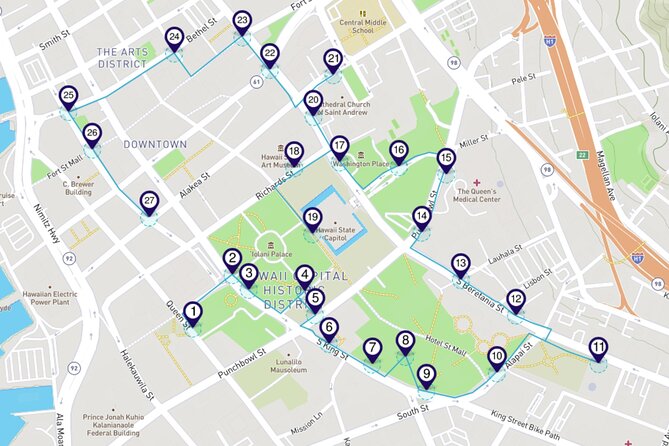
Reviewed · HISTORICAL TOURS
Honolulu Historic District a Smartphone Audio Walking Tour
Honolulu’s historic center is easy to overlook when Waikiki’s beaches take the spotlight. This self-guided walk brings you into the capital’s older streets, where royal buildings, churches, memorials, theaters, and civic landmarks tell the story of Hawaii’s changing government. Aliʻiolani Hale and King Kamehameha’s statue make a strong opening pair.
I like the freedom to start whenever you want and pause whenever you please. I also like the price: at $10.99, this is a low-cost way to spend one to two hours downtown, especially if you download the tour before leaving your hotel. The main drawback is clear: this is an outdoor audio tour only, so it does not include entry to Iolani Palace or any other attraction.
In This Review
- Key points to know before you go
- Starting at Aliʻiolani Hale and King Kamehameha
- Libraries, churches, and the memory of Hawaii’s rulers
- Honolulu Hale and the city’s civic center
- Police history, peace symbols, and Queen Emma’s institutions
- From the State Capitol to Washington Place
- Churches, squares, and the old commercial core
- Hawaii Theatre and local performance culture
- How the audio format works in practice
- Is $10.99 good value?
- Who should choose this Honolulu walk?
- Should you book it?
- FAQ
- Where does the tour start?
- Where does the tour end?
- How long does the walking tour take?
- Is this a guided group tour?
- Is palace admission included?
- Do I need mobile data during the walk?
- Do I need headphones?
- What language is offered?
- Can I cancel for a refund?
Key points to know before you go

- Royal Honolulu begins at Aliʻiolani Hale: The route starts beside one of the city’s most important government buildings and moves quickly into Hawaii’s monarchy.
- GPS audio keeps you moving: Commentary plays automatically at each point of interest while the live map shows your route and location.
- You visit more than royal sites: Churches, libraries, theaters, statues, civic buildings, and public art give the walk a broad view of Honolulu.
- Download first: The tour uses no mobile data once downloaded, but you need your own smartphone or tablet.
- Bring earbuds: Some audio can be quiet through a phone speaker, especially near traffic or other city noise.
- Plan for sun and heat: Starting early makes the walk more comfortable, and the route can take longer than the advertised one to two hours if you stop often.
Starting at Aliʻiolani Hale and King Kamehameha
The tour begins at Aliʻiolani Hale, at 417 South King Street. Its Hawaiian name means House of the Heavenly Kings, and the building was created in 1879 for King Kalakaua, the Hawaiian Kingdom’s ruler.
That first stop gives you a useful frame for the rest of the walk. Honolulu’s downtown is not just a collection of old facades. It is where the monarchy, later governments, religious institutions, immigrant communities, and modern civic life meet in a fairly compact area.
Nearby, King Kamehameha I’s statue brings one of Hawaii’s best-known figures into the story. The audio adds folklore about the celebrated monarch, which gives the stop a more human feel than a simple date-and-name explanation. This is also a good place to understand how public memory works in Hawaii. The statue is not only a landmark for photographs. It represents the unification of the Hawaiian Islands under one ruler.
The Kanaina Building follows with a different architectural mood. Added to the National Register of Historic Places in 1978, it is an important Victorian example in Hawaii. The stop helps you notice details you could easily walk past on your own, particularly if your attention is fixed on the larger royal buildings.
The route then introduces Patsy, whose statue honors her accomplishments. The supplied tour information does not identify her by a full name, so the audio itself provides the needed context. This stop adds a modern political voice to a walk that begins with kings and queens.
More audio tours of Oahu:
- Diamond Head Official Self-Guided Narrated Audio Tour
★ 3.0 · 212 reviews - Pearl Harbor Aviation Museum Ticket with Audio Tour and Shuttle
★ 4.5 · 58 reviews - Oahu Grand Circle Island Audio Driving Tour
★ 4.5 · 37 reviews
Libraries, churches, and the memory of Hawaii’s rulers
One of the more appealing stops is Hawaii’s State Library. It began in 1879 as a simple reading room, partly intended to keep unruly sailors occupied and out of trouble. That small detail makes the building memorable. It also shows how a public institution can begin with a practical local need and grow into something much larger.
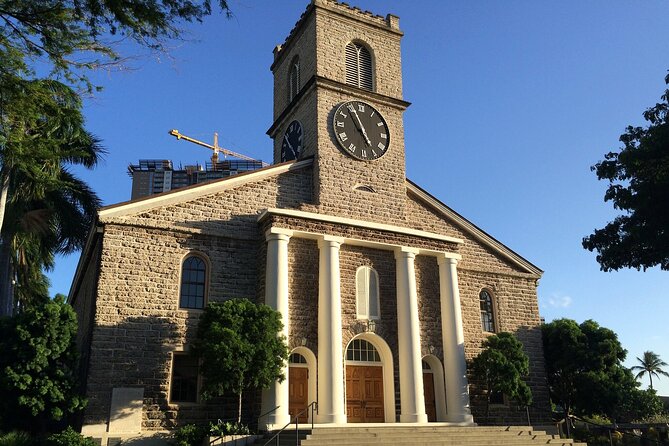
Next comes Hawaii’s oldest church. The audio explains its place in the city and the wider story of Christian worship in the islands. You can listen from outside, but remember that the ticket price does not cover admission to any attraction. The value here is the setting and the explanation, not an interior visit.
King Lunalilo’s burial site adds another royal chapter. He refused to be interred in the Royal Mausoleum and instead lies here. That choice gives the stop a personal edge. It is a reminder that royal traditions were not always followed in the expected way.
The tour is strongest when it connects architecture with people. Rather than treating every building as a photo stop, it usually gives you a reason to care about the site. The tradeoff is that not every stop will carry equal weight. Some are major landmarks, while others are brief points on the route that may matter more to local history than to a first-time visitor.
Honolulu Hale and the city’s civic center
Honolulu Hale receives attention for its construction and impressive design features. This is the point where the walk shifts from monarchy and worship toward municipal government. The building helps explain how Honolulu developed an administrative center of its own.
Another stop asks why the years 1820 and 1915 appear on the front of a building constructed in 1921. That puzzle is a good example of how the audio format adds value. Without context, engraved dates can look like decoration. With an explanation, they become clues to the institutions and events connected with the site.
The route also pauses at an unusual sculpture tied to a natural phenomenon. The tour explains why the artwork looks so strange and tells the story behind it. This kind of stop breaks up the older architecture and gives the walk a lighter, more curious turn.
The Frank F. Fasi Building, Honolulu’s municipal building since 2006, adds a modern contrast. Its design is intentionally distinctive, and the commentary explains why. You get a sense of Honolulu as a living capital, not an open-air museum frozen in the nineteenth century.
On the grounds of Seagull Schools, relaxed-looking stone figures offer another unexpected sight. The setting is an early childhood education center, and the sculptures give the area a friendly, informal character. These smaller stops are useful if you enjoy public art and neighborhood details. If you mainly want royal palaces, you may find them less compelling.
Police history, peace symbols, and Queen Emma’s institutions

The Honolulu Police Department stop gives you a detail unique to the city’s police force. The supplied information does not spell out the fact in advance, so you will need to hear the commentary for the full explanation. This is one reason to keep the audio running even when a building looks ordinary from the sidewalk.
The Bell of Nagasaki introduces a different subject. It symbolizes peace and friendship between the United States and Japan. After royal history and city government, this stop widens the story to international relations and the lasting memory of war.
The Queen’s Conference Center is presented as a historic and cultural landmark. Nearby, the larger complex connected with Queen Emma and King Kamehameha IV reveals their vision for Hawaii. These stops are valuable because they show the royal family working not only as rulers, but also as planners of institutions intended to serve the public.
At this point, you may notice that the tour is not organized around a single grand attraction. It creates a chain of related places. The result is less dramatic than entering a palace, but it gives you a broader sense of how Honolulu’s institutions fit together.
More self-guided routes around Oahu:
- Chief’s Official Pearl Harbor Self-Guided Multimedia Tour
★ 4.0 · 407 reviews - Self guided Hike Trail to Nature Walk & Waterfall
★ 4.5 · 283 reviews - Self-Guided Kayaking Discovery in Kailua, Oahu
★ 5.0 · 249 reviews - Manoa Falls Rainforest & Self-Guided Hike
★ 4.5 · 227 reviews
From the State Capitol to Washington Place

The Hawaii State Capitol officially became the state capitol in 1969. The audio supplies the building’s background and gives you a chance to compare modern state government with the monarchy-era buildings seen earlier.
Washington Place changes the tone again. This regal manor was built in 1842 by a clipper ship captain for his wife and young son. Its story shows how private homes, royal connections, and public life overlapped in nineteenth-century Honolulu.
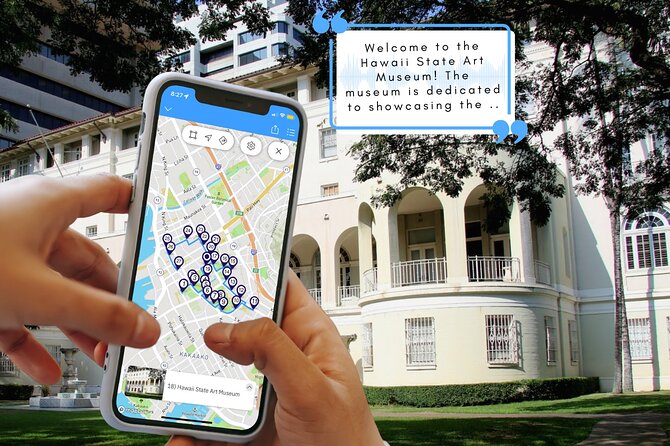
The tour then points you toward a museum devoted to Hawaii’s art and culture. The museum is described as a must-see for people interested in the islands’ traditions, but entry is not included in this audio walk. Treat the stop as an introduction. If the subject interests you, you can decide to return with an admission ticket.
A later stop brings in the last surviving member of the Kamehameha dynasty through a first-person-style historical passage. This artistic approach is one of the tour’s nicer touches. Hearing history framed as something the queen herself could have said may make the royal succession easier to follow than a dry list of names.
Churches, squares, and the old commercial core

Another magnificent place of worship reflects a dream shared by King Kamehameha and Queen Emma for Hawaii. The route uses this building to return to the royal couple’s religious and civic aims.
Originally named for Queen Emma, the nearby square now also honors James and Abigail Campbell. This small public space helps connect royal memory with later civic recognition. It is an easy stop to pass without the audio, but the explanation gives the name and setting more meaning.
Fort Street Mall brings you into the commercial heart of downtown. The pedestrian-only street was created in the 1960s as part of an effort to renew the area. Today it remains a place for shopping, dining, and entertainment. The route’s inclusion of this street matters because it shows that historic Honolulu is not limited to government buildings. It is also a working urban district.
You can extend your own afternoon toward Chinatown after finishing the official route. That area is not part of the stated tour, but it is a sensible add-on if you want more downtown atmosphere, food, and street life. Allow extra time, since the route already may run longer than two hours when you stop for photos or breaks.
Hawaii Theatre and local performance culture

Hawaii Theatre Center opened in 1922, during the era of vaudeville and silent movies. The building represents Honolulu’s entertainment past and gives the walk a welcome change from churches, monuments, and government offices.
The next stop concerns a building donated to Kumu Kahua Theatre Company. The company was formed to produce new works by Hawaii playwrights and plays reflecting the islands’ different cultures and experiences. This is an especially useful stop if you care about local voices rather than only famous royal names.
The final stop explains how builders searched for a substitute for the bricks familiar to newcomers from the mainland and elsewhere. The answer is part of Hawaii’s practical building story. It shows how local materials and conditions shaped the city’s architecture.
Taken together, the later stops make the tour feel broader and more grounded. You move from kings and queens to libraries, theaters, schools, police, public art, and construction methods. That range is one of the best reasons to choose this walk.
How the audio format works in practice
You receive a mobile ticket and should download the tour over Wi-Fi before you begin. Once it is stored on your device, the route does not require a signal and uses no mobile data. Your phone or tablet is not supplied, and headphones are optional.
The app provides a live GPS map with your position and the route. Commentary plays automatically at each point of interest, so you do not need to keep checking a printed guide. You can also pause, linger, skip a stop, or take a different route when you want.
I would bring earbuds. Audio can be quiet through the phone’s speaker, and downtown streets are not always calm. Comfortable shoes, water, and sun protection are sensible choices, though the supplied details do not promise shade or rest stops.
The tour is sold for flexible use rather than one fixed departure. The stated operating window runs from July 28, 2020 through February 16, 2027, every day from midnight to 11:30 p.m. In practical terms, you can choose an early morning start to reduce heat and sun. One person who completed it early found that timing helpful and also found the walk longer than expected.
This is a private activity for your own group, not a shared guided walk. Customer service is available by phone and email. Service animals are allowed, public transportation is nearby, and most people can take part.
Is $10.99 good value?
At $10.99 per person, the price is easy to justify if you want structure and background without paying for a live guide. You receive a route, location-aware audio, historical narration, and the ability to use the tour at your own pace. A couple can spend roughly $22 for an organized introduction to central Honolulu.
The value drops if you expect to enter a palace, church, museum, or other attraction. No admission tickets are included. One purchaser expected palace access and was disappointed, but the product is specifically an outdoor walk, not an interior palace tour.
That distinction is important. If your main goal is to tour Iolani Palace inside, buy an on-site palace ticket or a separate palace audio tour. If you want to walk around the surrounding historic district and learn what you are seeing from the pavement, this product is the better match.
You can cancel for a full refund up to 24 hours before the start time. Changes or cancellations within 24 hours are not refunded.
Who should choose this Honolulu walk?
I would recommend it to independent visitors who like history but do not want to follow a guide’s fixed pace. It suits solo visitors, couples, families with older children, and anyone with a free afternoon near downtown.
It is also a good first activity in Honolulu if you want to understand the city beyond Waikiki. The route introduces royal Hawaii, civic government, churches, architecture, public art, and local theater in one outing.
I would be more cautious if you dislike listening through a phone, need guaranteed indoor access, or want every stop to be a major attraction. The route includes several smaller civic and artistic points, and a few may feel less exciting than the major royal sites.
Should you book it?
Book this tour if you want a cheap, flexible introduction to downtown Honolulu and are happy to stay outside. Download it on Wi-Fi, start early, bring earbuds, and leave room for the route to run beyond one hour.
Skip it if palace admission is your priority. In that case, arrange the palace visit separately and use this walk only if you still want the surrounding district. For most independent visitors, the combination of low cost, no data use, automatic GPS narration, and control over the pace makes this a sensible way to spend part of an afternoon.
FAQ
Where does the tour start?
It starts at Aliʻiolani Hale, 417 S King Street, Honolulu, Hawaii 96813.
Where does the tour end?
The activity ends back at the meeting point.
How long does the walking tour take?
The estimated duration is one to two hours, though it can take longer if you walk slowly, pause often, or spend extra time at the stops.
Is this a guided group tour?
No. It is a private, self-guided activity for your own group. Audio commentary plays automatically at each point of interest.
Is palace admission included?
No. Attraction tickets are not included, and the experience is an outdoor walking tour.
Do I need mobile data during the walk?
No. Download the tour over Wi-Fi before you begin. After that, no signal is required and no mobile data is used during the tour.
Do I need headphones?
Headphones are optional. Audio plays through your device speaker, but earbuds are useful because some of the commentary may be quiet.
What language is offered?
The tour is offered in English.
Can I cancel for a refund?
Yes. You can cancel at least 24 hours before the experience start time for a full refund. Cancellations within 24 hours are not refunded.
More Walking Tours in Oahu
- Honolulu Haunts: Ghosts and Spirits Walking Tour
★ 4.2 · 169 reviews - Honolulu Downtown Walking Tour
★ 5.0 · 149 reviews - Kualoa Ranch – Horseback Walking Tour
★ 4.0 · 145 reviews - Ghosts of Old Honolulu Walking Tour
★ 4.5 · 53 reviews
More Historical Tours in Oahu
- Oahu: Mauka Warriors Luau Honoring Polynesia’s Forgotten History
★ 5.0 · 3,013 reviews - Pearl Harbor History Remembered Tour from Ko Olina
★ 5.0 · 1,009 reviews - Pearl Harbor with USS Arizona and Hawaiian Kingdom History Tour
★ 4.5 · 184 reviews - Pearl Harbor [Early Access], USS Arizona & Historic Honolulu Tour
★ 4.5 · 87 reviews
Just added around Oahu
- Koko Head E-Bike Ride and Hike Tour★ 5.0 · 3 reviews
- Waikiki: Sunset Swim & Sailing Experience★ 4.5 · 3 reviews
- Diamond Head Hike [Starts at 7:00 a.m.]★ 3.5 · 3 reviews
- Honolulu’s Waikiki Self-Guided Walking Audio Tour★ 4.5 · 3 reviews
- Oahu : Hanauma Bay Reservation+Equipment Rental★ 3.3 · 3 reviews
- Private Whale Watching Safari from North Shore Oahu★ 5.0 · 3 reviews
- Oahu: Half-Day Sunrise Semi-private Tour from Waikiki★ 3.0 · 3 reviews
- Self Guided Hike Trail to Nature Walk & Waterfall★ 3.2 · 3 reviews
Historical Tours, compared.

Mauka Warriors Luau Honoring Polynesia’s Forgotten History
Read our review →


Through A Glass Darkly The Strange and Tragic History Of Honolulu
Read our review →

Best Oahu Self-Guided Driving Audio Tour: Beaches, History & More
Read our review →
Historical Tour of Downtown Honolulu in Red Light District
Read our review →
Browse the lists this tour appears in